
Honey bees are often treated as one of agriculture’s simplest tools. Move them to where crops are flowering, and they will do the rest. Pollination improves, yields increase, and food systems benefit.
It is a neat idea. Move honey bees, boost crops, solve the problem. But that thinking is increasingly out of date. What sounds simple on the surface poses real risks to the natural systems that support our biodiversity. Every drop of honey, every layer of wax, every trace of propolis is gathered from the plants, trees, and resins in the environment around them. A hive is an active participant in the ecosystem.
When large numbers of managed honey bees are introduced into an area, the pressure on that environment extends far beyond pollination.
It affects which plants are visited, how often, and how much resource is removed from the system.
What looks like a simple agricultural input is, in reality, a complex biological force interacting with everything around it.
Across the world, scientists are beginning to challenge the assumption that honey bees are interchangeable units that can be moved freely without consequence. What is emerging instead is a far more complex picture.
What we’re starting to understand is that it’s not that simple. Honey Bees aren’t just workers we can move around to pollinate crops. They’re part of a much bigger, more delicate system, shaped by the place they live, the climate, and their long relationships with other plants and animals.
In South Africa, this complexity is particularly important.
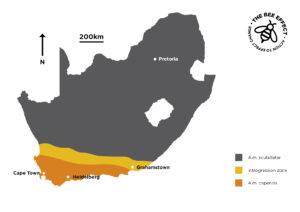
The country is home to two subspecies of honey bees, each adapted to specific regions. One of these, the Cape Honey Bee, known scientifically as Apis mellifera capensis, is found naturally in the southern parts of the country. It is not simply a regional variation. It behaves differently in ways that matter.
Unlike most honey bees, Cape Honey Bee workers can reproduce without mating. This allows them, under certain conditions, to infiltrate and take over other colonies. When this happens, the affected colonies weaken and eventually collapse. South Africa has already experienced the consequences of this within its own borders, where the movement of capensis into other bee populations led to widespread disruption in beekeeping and pollination systems.
Now, attention is turning to what happens when honey bees like these are moved beyond their natural range altogether.
The Issue at Hand
Large scale movement of managed Cape Honey Bee colonies into regions north of their natural introgression zone is said to be taking place. To those outside the beekeeping world, this may sound like routine agricultural practice. But scientists are warning that the risks extend far beyond individual hives.
The reason lies in how pollination actually works.
For many years, pollination was understood in simple terms. Bees visit flowers, transfer pollen, and enable plants to reproduce. If more pollination is needed, more bees can be introduced. This logic has shaped agricultural practices globally.
Recent research is showing that this model is incomplete.
Studies mapping pollination systems, including large-scale work in countries like Chile, have revealed that ecosystems function as networks rather than simple exchanges. Plants and pollinators are linked through thousands of interactions, forming systems that are structured, balanced, and locally adapted over time. What this means simply is that plants and pollinators don’t just interact randomly. Over many years, specific bees, insects, and plants have learned to work together in ways that suit that particular place. Certain pollinators visit certain flowers more often, at the right time, in the right conditions. These repeated relationships create a kind of natural balance, where everything fits together and supports everything else.
So within these networks not all pollinators play the same role. They specialise in certain plants. Others operate at different times of day or under different environmental conditions. Together, they create resilience. If one species declines, others can compensate.
When a new pollinator like the honey bee is introduced, especially one that is highly adaptable or dominant, it does not simply slot into this system. It can change it.
Research shows that introduced honey bees often visit a wider range of plants and do so more frequently than many native pollinators. This can shift pollination patterns, favouring some plants over others and gradually altering the structure of the environmental network itself. These changes are rarely dramatic at first. They unfold slowly, through small shifts in behaviour and competition.
Over time, however, the effects accumulate.
Native pollinators can be displaced. Plant reproduction patterns can change. Some species begin to decline while others become more dominant. The system adjusts, but not always in a way that supports biodiversity or long-term stability. In plain terms, it means that the pollinators that naturally belong in an area can get pushed out. Some plants stop getting pollinated properly, while others start taking over. Over time, the balance shifts. You can end up with fewer types of plants and pollinators, and the whole system can become less stable and more vulnerable to collapse.
This is what scientists mean when they say ecosystems are being reshaped.
In the context of South Africa, introducing the Cape Honey Bees beyond their natural range adds another layer of risk.
It is not only about competition within pollination networks. It is also about the unique biological traits of the capensis honey bee itself.
If these honey bees integrate into other honey bee populations, the same patterns of colony infiltration and collapse seen within South Africa could begin to play out elsewhere. There is no simple way to detect or remove capensis once it becomes established. By the time its presence is clear, the impact is already unfolding.
There are additional concerns. The movement of managed honey bees is known to contribute to the spread of diseases and parasites. In regions without comprehensive baseline data or monitoring systems, these risks are difficult to measure and even harder to control.
Taken together, the picture is no longer one of a straightforward agricultural pollination practice.
It is the movement of a living system into another living system, with consequences that extend beyond farms into wider landscapes.
Put simply, this isn’t just about moving honey bees to help crops grow. It’s about introducing one living system into another, and once that happens, the effects don’t stay on farms. They spread into the surrounding environment, with consequences we can’t easily control or reverse.
This is why a growing number of voices within the sector are calling for caution. Not as a rejection of agricultural development or regional cooperation, but as a recognition that the science has moved on. And we need to take heed of its message.
South Africa’s experience with capensis has already shown how difficult it is to manage once boundaries are crossed. The newer ecological research from Chile adds to this by showing that even without such traits, the introduction of non-native or dominant pollinators like honey bees can alter entire ecosystems over time.
The combination of these two realities raises a clear question.
If the outcomes are uncertain, the impacts potentially irreversible, and the systems involved more complex than previously understood, should such movements be happening at all?
For now, there is no easy answer. But there is a growing consensus on one point.
When it comes to moving honey bees beyond their natural range, the risks are no longer theoretical. They are simply not yet fully visible.
And the big question from The Bee Effect? Why is the beekeeping industry not putting a stop to the unethical beekeeping of moving the Cape Honey Bee above its introgression zone, because beekeepers know the risks – with or without formal scientific backing on broader biodiversity impacts. Not least of which, it’s against the law, which everyone knows.
Reference Reading
Muschett, G. & Fontúrbel, F.E. (2022).
A comprehensive catalogue of plant–pollinator interactions for Chile. Scientific Data, 9, 78.
https://www.nature.com/articles/s41597-022-01195-8
Supports:
- Pollination as a complex network of interactions
- Large-scale mapping of plant–pollinator relationships (2,600+ interaction records)
Marinho, R.C. et al. (2026).
Silent takeover: How invasive bees reshaped plant–pollinator interactions in a biodiversity hotspot. Biological Invasions.
https://agris.fao.org/search/en/providers/122436/records/699591f6e6c33ba92ad5dc11
Supports:
- Invasive pollinators reshape ecological networks
- Dominance of non-native bees (e.g. Bombus terrestris dominating 73% of interactions)
- Generalist behaviour driving structural change in ecosystems
Cortés-Rivas, B. et al. (2023).
Pollination by native bees achieves high fruit quantity and quality of highbush blueberry: a sustainable alternative to managed pollinators. Frontiers in Sustainable Food Systems, 7, 1142623.
https://www.frontiersin.org/articles/10.3389/fsufs.2023.1142623/full
Supports:
- Native pollinators can be equal or superior to managed honey bees
- Importance of local adaptation in pollination systems
Medel, R. et al. (2018).
The most effective pollinator principle applies to new invasive pollinators. Biology Letters, 14(6).
https://pubmed.ncbi.nlm.nih.gov/29899130/
Supports:
- Plants shift toward the most dominant/effective pollinator, reinforcing ecological change
- Mechanism for how introduced species reshape plant evolution and interaction patterns
Valdivia, C.E. et al. (2025).
Nectar robbing by the invasive bumblebee Bombus terrestris changes the behavior of native flower visitors. PeerJ.
https://pubmed.ncbi.nlm.nih.gov/41142302/
Supports:
- Introduced pollinators can alter behaviour of native species
- Subtle behavioural shifts as early indicators of ecosystem change
Roubik, D.W. (2009).
Invasive Africanized honey bee impact on native solitary bees: a pollen resource and trap nest analysis. Biological Journal of the Linnean Society, 98(1), 152–160.
https://academic.oup.com/biolinnean/article/98/1/152/2235993
Supports:
- Competition for floral resources between managed/invasive and native bees
- Long-term ecological pressure on native pollinators
- Supporting context on invasive pollinators
Rendoll-Cárcamo, J.A. et al. (2016).
First record of the invasive bumblebee Bombus terrestris on Navarino Island, Chile. Journal of Melittology.
https://journals.ku.edu/melittology/article/view/6520
Supports:
- Global spread of managed pollinators through agricultural trade
- Establishment of bees as invasive species outside native ranges
Blog Image © Southern Gold Honey